It’s no secret that people in Singapore love to eat. Within this very publication are tantalising epicurean discoveries to be made, homages to the chefs worth knowing, the establishments worth making a reservation months in advance for, and a seemingly endless litany of tasting menus, buffets, and brunches.
Food is everything, everywhere, all at once. Which makes this statistic all the more uncomfortable: Almost 10 per cent of Singaporeans don’t have access to food all the time.
This is according to The Food Bank Singapore’s Hunger Report III, published in May. The report highlighted that an estimated 9.5 per cent of the local population experienced some form of food insecurity between 2022 and 2024.
In one of the wealthiest countries in the world, some children may go to school without breakfast. Or their parents eat less so that there’s enough for the kids. The elderly might stretch meals so that they last longer. And some households opt for cheaper, less nutritious food simply because there are more pressing concerns, such as bills to be paid.
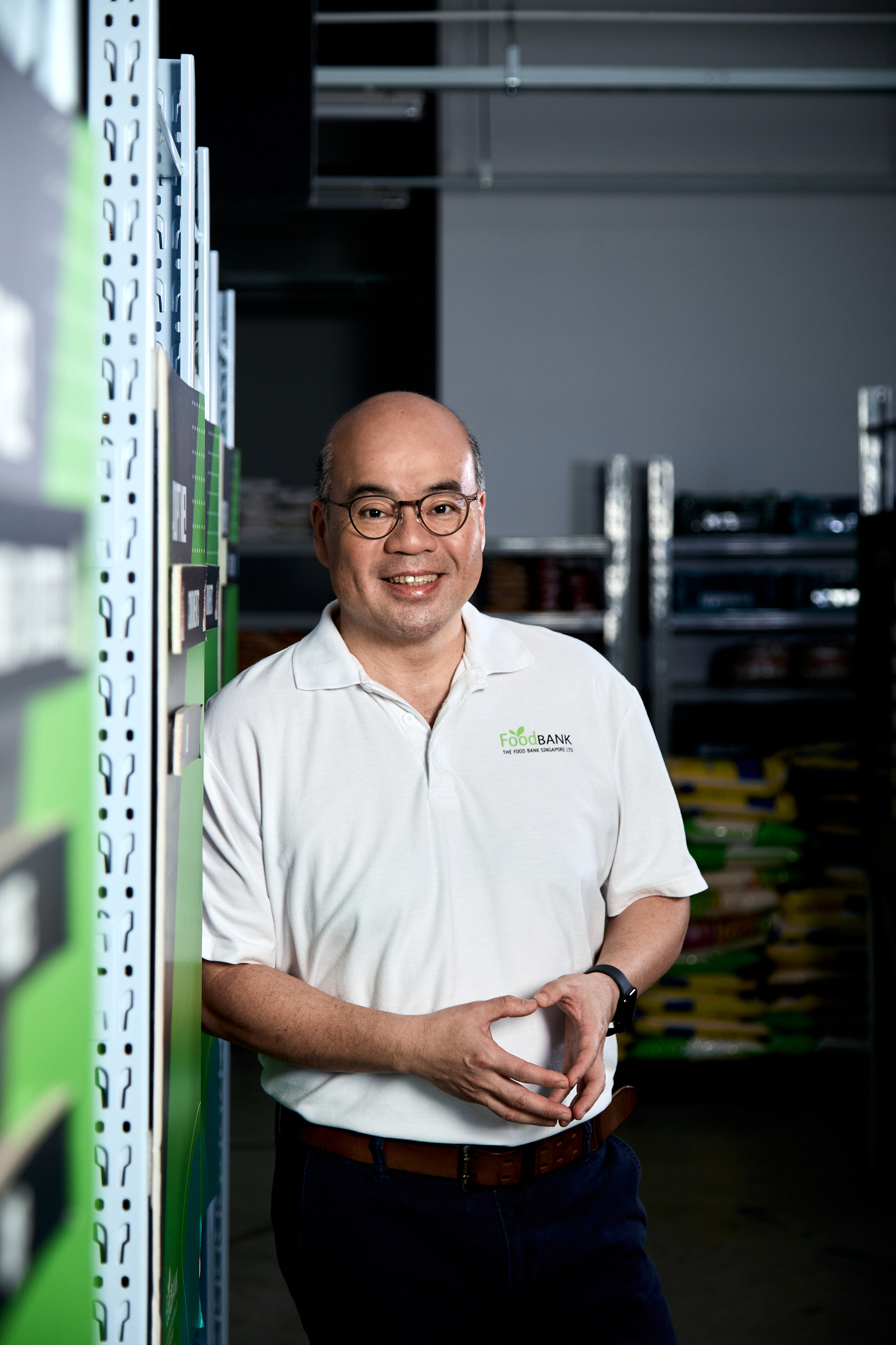
“Food insecurity does not always look like hunger or long-term poverty,” explains Arthur Chin, Executive Director of The Food Bank Singapore. “Sometimes it begins with one difficult event, a loss of income, illness, rising household costs, or a change in family circumstances.”
And, he points out, in an Asian society where there can be stigma around asking for help, the absence of people seeking assistance should not be mistaken for an absence of need.
For Chin, that is why food insecurity should not be viewed simply as a charity issue; it’s a question of social and economic resilience. “When communities are stronger, healthier, and more resilient, businesses thrive too,” he maintains.
(Related: Why Temus CEO Sng Ren Yeong believes AI transformation starts with people)
- FROM SHEEP FARMING TO FOOD BANKING
- BEYOND DONATIONS
- THE GENEROSITY OF SINGAPOREANS
From Sheep Farming to Food Banking
It’s a perspective honed by an unconventional career path: Chin spent 13 years managing a sheep farm in New Zealand before carving out a trail in banking, higher education, and government.
In 2024, he returned to Singapore and assumed the mantle at The Food Bank Singapore, and now clocks between 65 and 80 hours a week, “which is perhaps not that different from the hours I worked during my years in banking or as a sheep farmer,” he muses.
Sheep farming exposed him to the stark realities and complexities of food security. Farmers have to contend with climate and other environmental pressures beyond their control. There are also ever-increasing costs and an ageing workforce to adapt to. And then there are the distributors, retailers, and consumers, all of whom play a role in what ultimately reaches our plates – or not.
As Chin puts it, “Food security begins well before food reaches a supermarket shelf.”
In Singapore, the issue of food waste is also becoming increasingly important. The city-state generated 790,000 tonnes of it in 2025, a number that has grown steadily over the years. To mitigate the problem, Chin wants to encourage businesses to do some soul-searching, and relook how they operate – as it could well be a business efficiency problem hiding in plain sight.
For corporate offices, that might mean not overstocking the pantry or ordering more food than a meeting or event actually needs. For food manufacturers, better forecasting could reduce excess production. For an F&B or hospitality business, more accurate estimates of demand could mean fewer leftovers.
- FROM SHEEP FARMING TO FOOD BANKING
- BEYOND DONATIONS
- THE GENEROSITY OF SINGAPOREANS
Beyond Donations
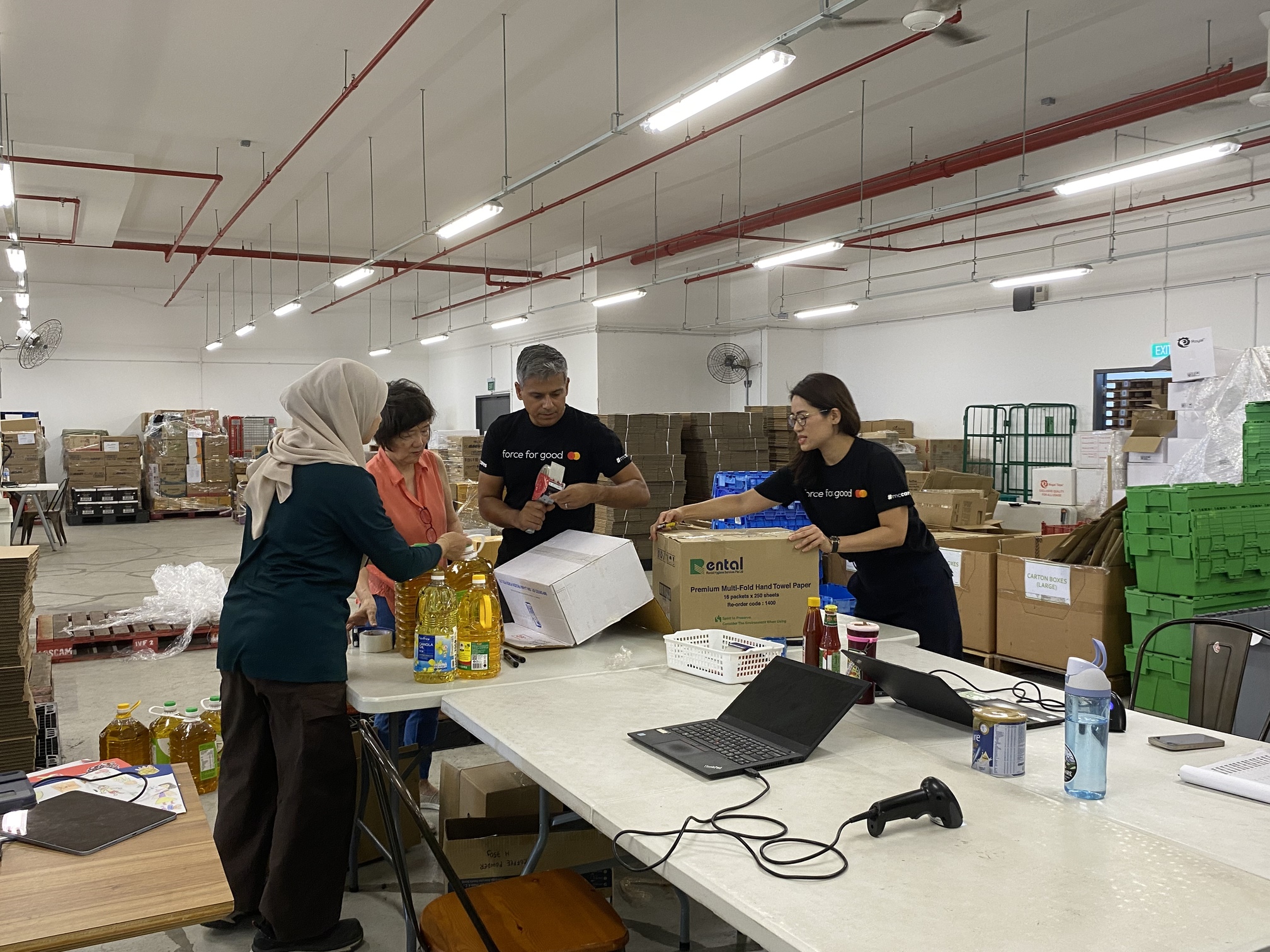 Volunteers at The Food Bank Singapore are involved in various warehouse duties, such as packing for community distribution programmes or delivery support
If and when surplus does occur, Chin says that businesses can offer more than simply donating food or writing a cheque.
“I would ask every CEO to choose one meaningful way their company can help strengthen the community, and commit to it consistently,” he says. That contribution could be food, funding, time, expertise, or simply opening doors for others.
For example, logistics companies can provide vehicles and manpower. Technology companies can contribute their skillsets to help improve operations. Professional firms can share their expertise or help train staff. Employees can volunteer at warehouses. And companies can open their networks and introduce new partners.
.jpeg) The Food Bank’s recent initiative – Adopt A Food Bank Box
The Food Bank’s recent initiative – Adopt A Food Bank Box
Even SMEs, which lack the resources of large corporations, can play their part. One example is The Food Bank Singapore’s recently launched campaign, "Adopt a Food Bank Box", which the National Volunteer & Philanthropy Centre (NVPC) supported as an impact partner.
“Cheng Heng Paper Products provided carton boxes for the campaign,” explains Chin, while “logistics company Call Lade Enterprises contributed their logistics fleet to help collect the filled food bank boxes.”
The lesson there was about partnership, because different organisations come with different priorities. A business may be looking at employee engagement or community impact; a government agency may want to drive community development; a charity may be focused on reaching people who need support.
The challenge, says Chin, is finding the point where those interests overlap.
- FROM SHEEP FARMING TO FOOD BANKING
- BEYOND DONATIONS
- THE GENEROSITY OF SINGAPOREANS
The Generosity of Singaporeans
For Chin, the move to The Food Bank Singapore has brought together the lessons of a career spanning banking, higher education, and government – but in a setting where the impact can be felt almost immediately.
“What I find especially meaningful is that the impact of our work is tangible,” he says. “You can see how a partnership, a food donation, a programme, or a simple act of generosity can make life a little easier for someone else.”
The work, however, is far from straightforward. Chin says running a charity means navigating complex social issues, limited resources, and constantly changing needs, often without the specialist teams or infrastructure available to larger organisations.
But he has also been struck by something else: The generosity of Singaporeans.

“What I find especially meaningful is that the impact of our work is tangible. You can see how a partnership, a food donation, a programme, or a simple act of generosity can make life a little easier for someone else.”
“We see it from businesses, family offices, volunteers, food donors, and individuals who simply want to help,” he says.
Perhaps that is where the opportunity lies. In a city known for its abundance, the resources to make a difference already exist – not just in the form of ample finances or surplus food, but in expertise, infrastructure, networks, and time.
The issue is simply to put them to work.
For those interested to volunteer at The Food Bank Singapore, click here








 Back
Back