Each year, Namiki unveils a limited edition fountain pen that serves as a reminder of why the Japanese house remains one of the world’s most respected names in Maki-e. In 2025, that reminder arrived as a work of extraordinary depth and symbolism. 百花繚乱, or “Blooming Flowers in Profusion”, is a celebration of artistic resilience, cultural heritage, and the collective mastery of the Kokkokai artisans who continue to elevate this centuries-old craft. More than an object of beauty, the new release is also a reflection of the human hands, stories, and philosophies that brought it into being.
The pen’s journey began under difficult circumstances. Originally set for release in 2024, its completion was delayed after the Noto earthquake devastated parts of Ishikawa Prefecture, a region where many Kokkokai artisans live and work. In the aftermath, the artisans chose to continue creating, guided by quiet resolve and a shared sense of purpose. The final work carries that spirit. It is a reminder that craft endures not only through skill or tradition, but through community and the ability to find renewal in the act of making.
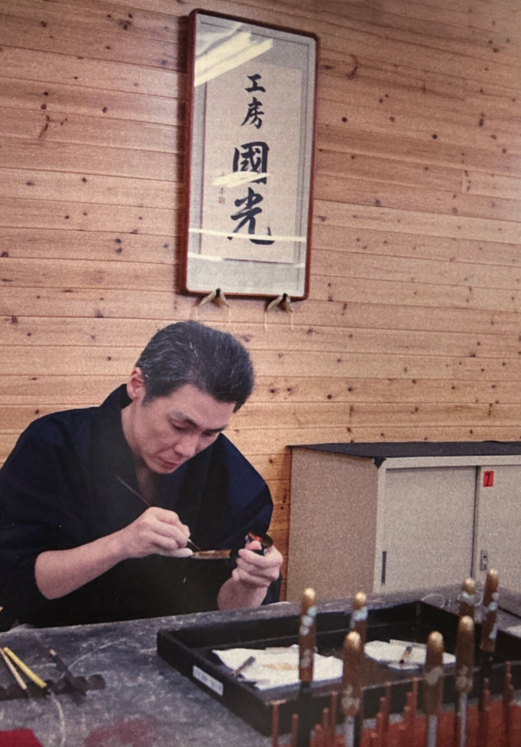
This limited edition pen is created by Kokkokai artisan Yutaka Sato, who has been responsible for celebrated Namiki pieces including the 2011 Golden Flower and the 2019 Shoki. For “Blooming Flowers in Profusion,” he turned to the Japanese idiom Hyakkaryouran. In Japanese culture, the phrase evokes a scene of flowers blooming at once, symbolising creative harmony, diverse talents flourishing together, and the beauty of collective brilliance. For Sato, the idiom captured not only the ethos of Kokkokai, but the collaborative nature of crafting a Namiki fountain pen.
Although each pen is led by a single artisan, its creation calls on many hands. “The techniques chosen allow every bloom to hold its own character, while creating movement and vitality across the surface,” Sato shares. “Just as the flowers symbolise the flourishing of many, the talents of each artisan unite to bring the pen to life.” His intention was to tell a story of connection, not as metaphor but as lived experience. The pen is therefore both an artwork and a quiet tribute to the community behind it.
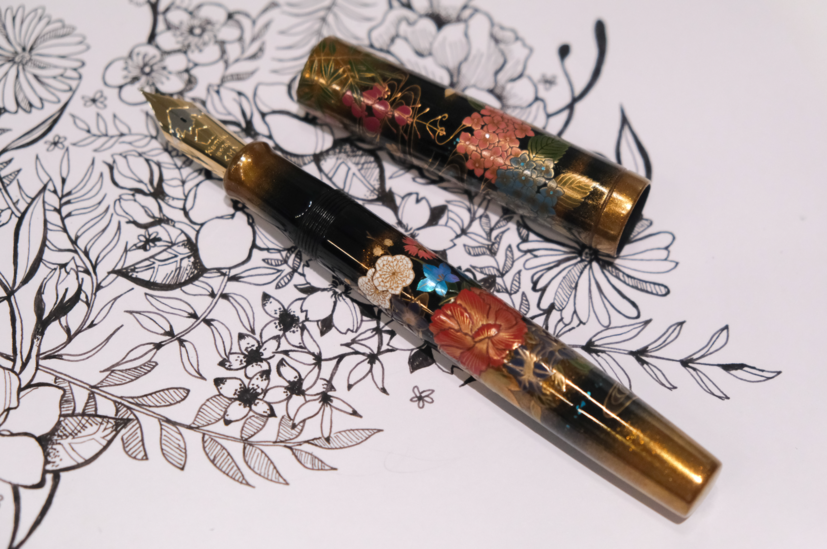
Across its lacquered surface, eleven flowers unfold in meticulous detail, each chosen to represent a distinct moment in Japan’s four seasons. Spring opens with cherry blossoms, violets, and wisteria, all created through Hira Maki-e. The technique requires repeated layering, sprinkling, sealing, and burnishing of gold and silver powders until the flowers sit in luminous clarity. Summer follows with clematis and sweet lily, while the hydrangea incorporates Raden inlay, using slivers of abalone shell to create movement and iridescence.
Autumn is rendered through a trio of techniques. Dianthus is created using Hira Maki-e, bellflowers glow with Raden inlay, and chrysanthemums rise in sculptural Taka Maki-e. Winter brings one of the pen’s most arresting elements. The plum blossom is depicted using Rankaku, which carefully places fragments of eggshell to create a soft, naturalistic finish. Meanwhile, the winter peony returns to the height and texture of Taka Maki-e. All of these seasonal blooms rest on a base of earth and flowing water created with the Togidashi-Taka Maki-e technique, which requires multiple layers of lacquer and polishing to reveal a shimmering interplay of depth, shadow, and reflected light.
(Related: Larger Than Life)
 Seiki Chida
Inside, the pen carries Namiki’s iconic No. 50 jumbo nib in 18K gold, the hallmark of the Emperor Collection. The oversized vest-type form lends presence and weight, while maintaining a smooth, fluid writing experience that connects the tactile act of writing with the serenity of the artwork that surrounds it. The pen is presented in a custom wooden box, framed by an abstract motif that mirrors the artistry within.
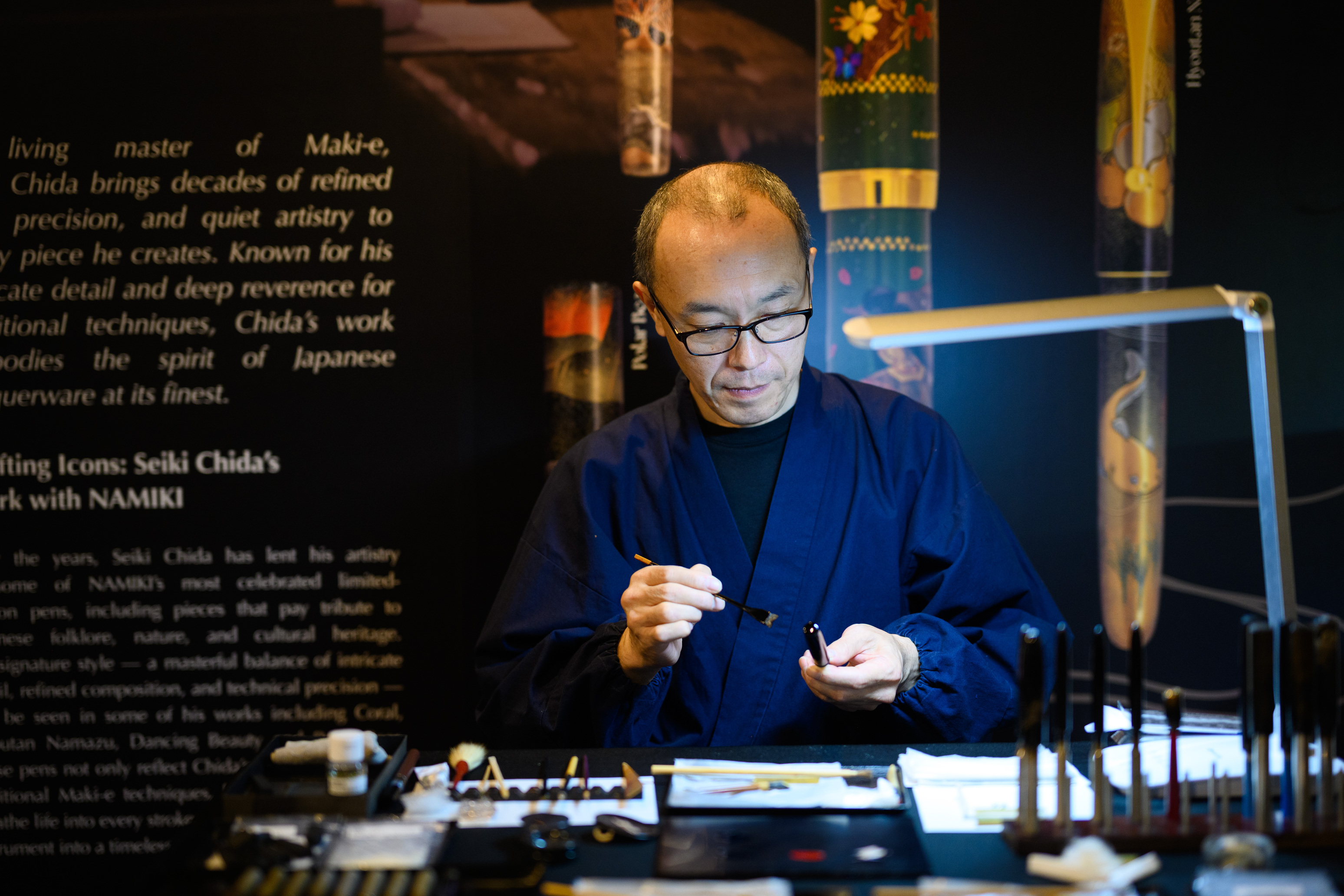
To understand the deeper philosophy behind Namiki’s work, it helps to hear from the artisans themselves. Senior Kokkokai artisan Seiki Chida, who has mentored younger artists for decades, offers a perspective shaped by both tradition and emotion. For him, Maki-e is a craft best learned through presence. Watching, touching, and repeating movements creates an instinct that cannot be taught through explanation alone. He sees teaching as an act of continuity, where skills are passed hand to hand, and where younger artisans learn not only technique, but the sensibility behind it.
Chida’s own creations are often tied to personal moments. His Hummingbird pen, made when he was preparing for marriage, became a symbol of tenderness and partnership. Another, the Goldfish pen, was created as he was about to become a father. “A Namiki pen is not just an instrument for writing. It is a vessel of emotion, memory, and artistry,” he says. He hopes that even without knowing the story behind a piece, the person holding it can feel its quiet intentions.
 Yutaka Sato
For Sato, who belongs to a younger generation within Kokkokai, the responsibility is twofold. He hopes to preserve the technique and philosophy of Maki-e while ensuring it continues to resonate with future audiences. Storytelling, education, and hands-on experiences, he believes, will help younger people understand the cultural depth behind the craft. “I hope future generations see Maki-e not as a static tradition, but as a living practice,” he says. “Careful study of the past can merge with curiosity and creativity to shape new forms.”





 Back
Back