There is a particular kind of institutional authority that cannot be manufactured, acquired, or replicated by even the most generously funded start-up. It accumulates, slowly, across generations – in the subtle confidence of a firm that has survived two world wars, prohibition, and the internet, and still considers itself, without irony, to be in the early stages of its ambition. Acker, established in New York in 1820, possesses this quality in a way that very few institutions in any industry can claim. And now, with the measured deliberateness of an organisation that does not do anything hastily, it has decided that Singapore is ready for it.
The arrival of Acker Wine Merchant in Singapore is best understood as an opening move rather than a destination. The firm’s current inventory here sits at approximately USD$3 million, part of a USD$20 million global portfolio, with Tokyo and Bangkok earmarked for expansion before the year is out. Chief Executive Officer Irvin Goldman – a former Salomon Brothers and JP Morgan Chief Investment Office veteran – describes it with the expansiveness of someone playing the long game. “It is our intention to build out our presence throughout Asia,” he says. “It is not a Hong Kong-versus-Singapore approach, but rather a global expansion with a personal touch in the most important markets.”
Singapore, in other words, is not the whole story. It is, however, where the story begins.
- BEFORE THE ALGORITHM, THE ARCHITECTURE
- WHERE THE ALGORITHM STOPS
- THE NINE PER CENT QUESTION
- THE HONEST ADMISSION
- WHAT 205 YEARS ACTUALLY BUYS YOU
Before the Algorithm, the Architecture
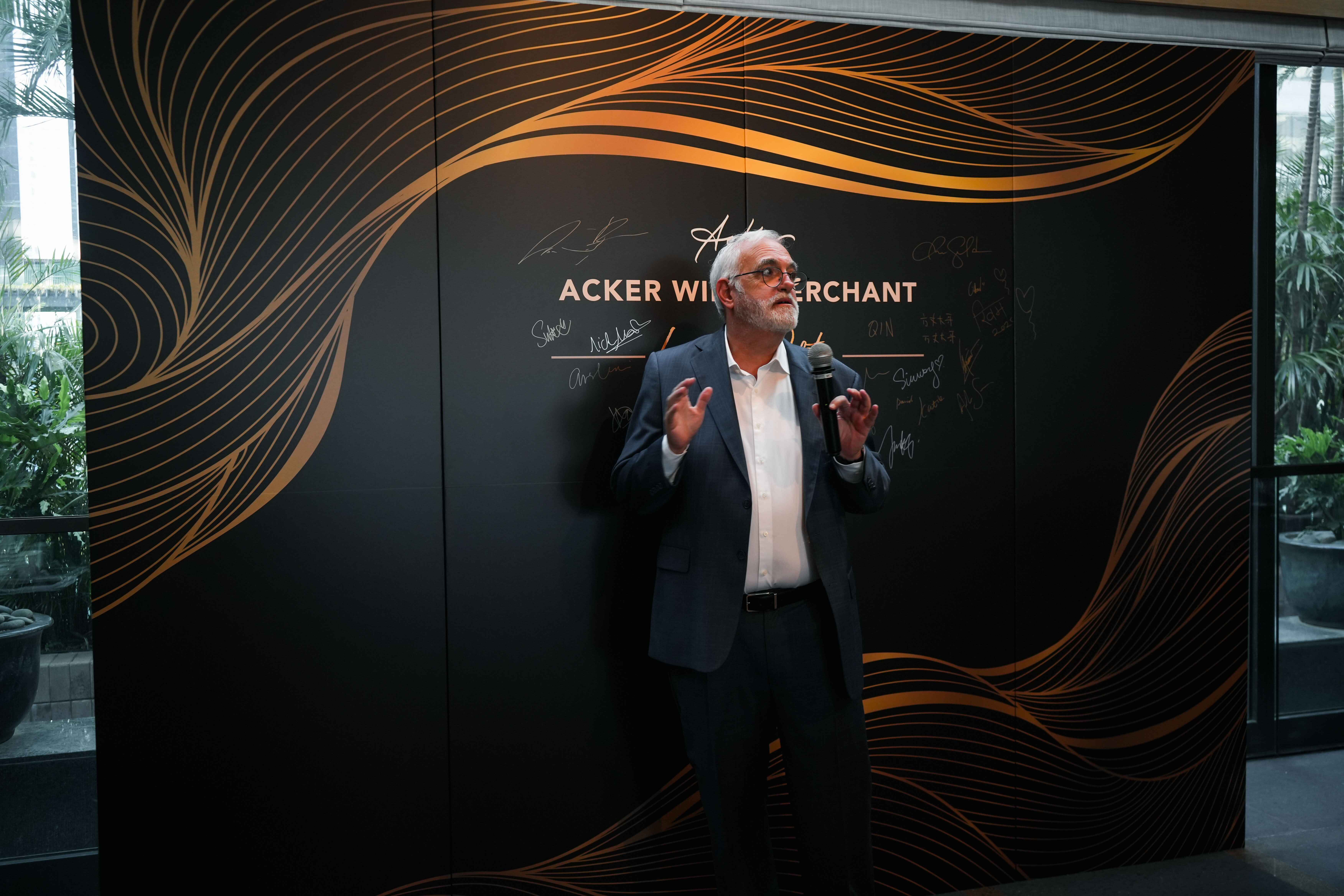 Irvin Goldman at the launch of Acker Wine Merchant in Singapore
Goldman is an interesting appointment for a house this old, and his presence tells you something deliberate about Acker’s direction of travel. What is less widely appreciated – and what distinguishes him from the familiar archetype of the Wall Street executive who discovers wine in his fifties and promptly declares it an asset class – is that Goldman has spent years quietly building the analytical infrastructure to justify that declaration.
Long before the current AI headline, he was constructing Acker’s proprietary pricing platform from scratch: two decades of raw auction data, unified across multiple languages and regions, covering every major wine category from classified Bordeaux to the broader world of fine wine that existing indices, in his assessment, had never adequately captured. The result is a dataset of a scope and geographic breadth that Goldman argues no external benchmark currently matches. It is a bold claim. It is also one that has been in construction for long enough to carry weight.
That foundation matters now because it is precisely what gives Acker’s current technological ambitions their credibility. The firm’s partnership with a major Google AI provider – its largest technology investment in two centuries of operation – is not a pivot towards innovation for its own sake. It is the logical next chapter of a data strategy that Goldman has been advancing, methodically, for years. The most concrete application he describes is rather arresting: an image recognition system trained on Acker’s archive of bottles from over USD$2 billion in transacted sales – including, pointedly, the rejected ones.
The capability it produces, detecting ultra-fine ink pixelation and micro-level visual markers beyond the threshold of the trained human eye, addresses one of the market’s most persistent and expensive vulnerabilities. Provenance fraud has long been the uninvited guest at the finest tables. Acker is, with some precision, showing it the door.
(Related: From highland roots to high-yield returns)
- BEFORE THE ALGORITHM, THE ARCHITECTURE
- WHERE THE ALGORITHM STOPS
- THE NINE PER CENT QUESTION
- THE HONEST ADMISSION
- WHAT 205 YEARS ACTUALLY BUYS YOU
Where the Algorithm Stops
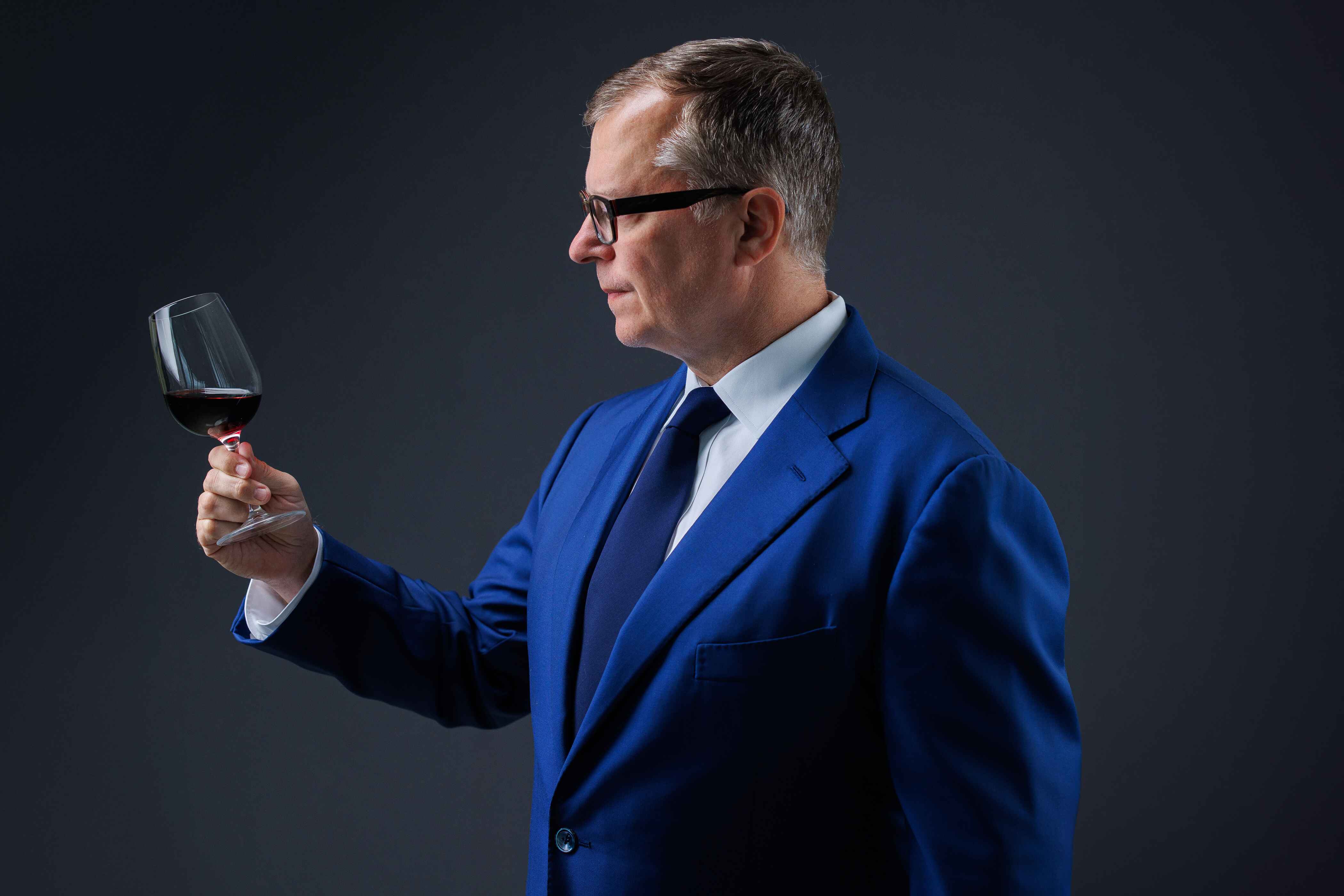 John Kapon
John Kapon, Acker’s Chairman, is the other half of a complementary pairing, and the more philosophically expansive of the two. Where Goldman provides the institutional scaffolding, Kapon supplies the animating conviction. “Technology doesn’t replace trust and deep market knowledge,” he says. “It amplifies it.” And later, with the precision of someone who has thought carefully about exactly where the line falls: “As we integrate more advanced technology into the business, it serves as infrastructure, not identity. Wine remains cultural, historical, and emotional.”
It is a distinction that matters enormously to the Acker client. The firm’s Wine Merchant Specialists – a human advisory layer that Kapon is insistent about preserving alongside the digital build-out – exist because, as he puts it with characteristic economy, “algorithms can display inventory. They cannot evaluate condition nuance, portfolio balance, or collector psychology.” For the UHNW buyer who is accustomed to being advised by people who actually know things, rather than interfaces that merely present them, this is a meaningful promise. Rather than a platform, Acker is building a practice — and the distinction, in an era of frictionless digital everything, is precisely what justifies the relationship.
- BEFORE THE ALGORITHM, THE ARCHITECTURE
- WHERE THE ALGORITHM STOPS
- THE NINE PER CENT QUESTION
- THE HONEST ADMISSION
- WHAT 205 YEARS ACTUALLY BUYS YOU
The Nine Per Cent Question
The investment conversation around fine wine has matured considerably in recent years – graduating from the enthusiast’s indulgence to the portfolio manager’s serious talking point – and nowhere is this transition more visible than in the private banks and family offices of Singapore. Kapon reads the regional landscape with the attentiveness of someone who has spent real time inside it. “More collectors are approaching wine as portfolio-building rather than trophy acquisition,” he observes – a generational evolution he attributes to rising digital access, greater price transparency, and a sophistication around long-term value that is reshaping how the region’s wealthiest individuals think about alternative assets.
His characterisation of the Singaporean buyer carries the specificity of direct experience: “sophisticated and disciplined... highly informed, focused on condition and long-term value, and decisive when the right bottle appears.” It is, one suspects, also a precise description of exactly the kind of client Acker has come here to find.
For those approaching the conversation from a purely financial vantage point, Goldman’s headline figure merits careful consideration: fine wine, on Acker’s proprietary data – built from global auction and retail volumes spanning every major wine category, in a dataset Goldman contends is more representative of true global activity than any available external benchmark – has averaged close to nine per cent annual returns over a ten-year horizon, with Burgundy and older Bordeaux delivering the strongest performance.
Understanding that Goldman constructed this dataset himself, with deliberate ambition to correct the narrowness of existing indices, lends the figure a credibility that a simple house claim would not. While the headline is genuinely attractive, the arithmetic beneath it remains, as with all alternative asset propositions, any discerning investors’ own exercise.
- BEFORE THE ALGORITHM, THE ARCHITECTURE
- WHERE THE ALGORITHM STOPS
- THE NINE PER CENT QUESTION
- THE HONEST ADMISSION
- WHAT 205 YEARS ACTUALLY BUYS YOU
The Honest Admission
On Burgundy specifically – the category around which Acker’s most prestigious inventory revolves, and the one most exposed to the realities of a changing climate – Kapon offers an honesty that is more reassuring than any bullish projection. The spring frosts that devastated the Côte d’Or in 2021, and the increasing frequency of extreme weather events pressing on even the most celebrated appellations, are not challenges that producer relationships, however long-cultivated, can circumvent. “No one escapes short vintages when frost or hail strikes,” he says, without hesitation.
What Acker’s decades-long connections with Burgundy’s great domaines do provide, he argues, is resilience – the institutional depth and sourcing network to access what exists more effectively than the competition when scarcity tightens, without pretending to manufacture supply where the vine has yielded nothing.
- BEFORE THE ALGORITHM, THE ARCHITECTURE
- WHERE THE ALGORITHM STOPS
- THE NINE PER CENT QUESTION
- THE HONEST ADMISSION
- WHAT 205 YEARS ACTUALLY BUYS YOU
What 205 Years Actually Buys You
In the end, there is a compelling case for what Acker is building across Asia. It rests on three pillars that reinforce one another rather than standing apart: a proprietary data architecture, years in the making, that prices the market with a scope and accuracy its competitors cannot readily replicate; an AI-driven authentication capability, trained on an unrivalled transaction history, that addresses the market’s most fundamental trust problem; and a human advisory layer that translates both into counsel a serious collector can act on.
It should be said that Goldman and Kapon are not in the business of promising that fine wine will behave like equity. They are in the business of making wine collecting more rigorous, more transparent, and – when the time comes – more gracefully exitable than the private arrangements that have historically served the market.
Whether that proposition speaks to you depends, ultimately, on your appetite for an asset that rewards patience above all else. Fine wine does not compound quarterly. It does not send push notifications. It has no interest in your hurdle rate. What it does, in the hands of the right custodian, is become something else entirely over time – less a financial instrument than a record of the world’s finest agricultural endeavour, held in trust for whoever eventually has the good fortune to open it.





 Back
Back