Gerald Li, the co-founder of Hong Kong-based hospitality group Leading Nation, does not speak about influence as something to be asserted. For him, it is something that reveals itself over time and often in retrospect. A queue forming without explanation; a café becoming a workplace or a regular meeting point; a restaurant remembered not just for what was served, but for how it made people feel.
Nearly two decades into his career, Li has come to understand that food and beverage is rarely just about food. “All our concepts go beyond pure food and drinks,” he says. “They are about art, music, design, and how people gather.”
That realisation crystallised early, when Elephant Grounds in Hong Kong was merely an idea. In 2013, Li and partner Kevin Poon were experimenting with a small counter tucked into the back of Poon’s lifestyle store, WOAW. There was no grand strategy, just a willingness to test something instinctive. Bulletproof coffee and ice cream sandwiches appeared on the menu, and quietly went viral, long before virality became industry shorthand.
Looking back, Li sees that moment as the beginning of a shift. Not a trend, but a change in behaviour. People were not just consuming products. They were identifying with a space. “Since then, all our concepts have been about more than what’s on the plate,” he says.
That philosophy would later scale with Elephant Grounds’ expansion, most notably with the opening of its Hollywood Road roastery in 2020. At over 7,500 square feet, the space was deliberately porous. People came to drink coffee, but also to work, bring their pets, or meet friends. Only later did Li recognise the language for what they had created. “Back then, we didn’t know it,” he reflects. “Culture later labelled it a third space.”
The distinction between passing trends and cultural shifts is something Li approaches from the guest’s perspective. He believes that the most enduring ideas are those that feel immediately intuitive, even if they are unfamiliar. “When people experience it, a light bulb pops without much thought,” he says. “That’s what creates memories.”
(Related: The Art of Influence – Koo Sok Hoon)

Trends, in contrast, are often defined by replication. He points to the ice cream sandwich phenomenon as an example. The product itself was not the point. It was the story, the scarcity, the sense of discovery. Once stripped of context, the trend faded. By contrast, concepts built around narrative, personality, and experience have the capacity to last.
This way of thinking has guided Li’s evolution from Liberty Private Works, his open-counter tasting menu restaurant co-founded in 2009 with chef Makoto Ono, to Elephant Grounds, and later to Forty-Five, a multi-concept hospitality destination at LANDMARK. Each arrived ahead of its time, yet none were conceived as provocations. They were responses to how Li and his collaborators lived, moved, and socialised.
Elephant Grounds, in particular, has become a lifestyle marker for a certain urban consumer. Yet Li resists the idea that this was ever intentional. “It was 100 percent organic,” he reveals. What began as one of the first F&B elements embedded within a retail environment has since become a familiar model globally. Fashion houses now routinely integrate cafés into their spaces, but when Elephant Grounds opened, the idea was still nascent.
That organic growth also shapes how Li thinks about responsibility. Rather than positioning himself as a tastemaker, he prefers to follow his own preferences and trust that resonance will follow. “We’ll continue to do things based on our lifestyle,” he says. “Hopefully it works for another ten years.”
If Elephant Grounds reflects Li’s instinct for community, Forty-Five demonstrates his ability to orchestrate collaboration at scale. Housing concepts such as Cristal Room by Anne-Sophie Pic, The Merchants, Cardinal Point, Sushi Mamoru, and Torikaze, the destination brings together Michelin-starred chefs, nightlife energy, and design-led hospitality under one roof.
Li’s leadership style in these environments is defined by restraint. Having worked with figures such as Albert Adrià, Hisato Hamada of WAGYUMAFIA, Anne-Sophie Pic, Vicky Cheng, and Vicky Lau, he believes influence is best exercised by creating space for others. “Let them work,” he says simply. “Empower them and build around their strengths.”
Where he adds value is in execution and honesty. He sees his role as supporting creative vision while being candid about viability. Influence, in this sense, is not about imposing taste, but about shaping conditions where ideas can succeed without losing their integrity.
As Leading Nation Hospitality expands across Southeast Asia, including the recent opening of Elephant Grounds in Singapore and upcoming locations in Jakarta and beyond, Li is acutely aware that influence must adapt across borders. “Gently educate and shape the market,” he says. This means engaging with local communities, listening, and allowing dialogue to emerge organically.
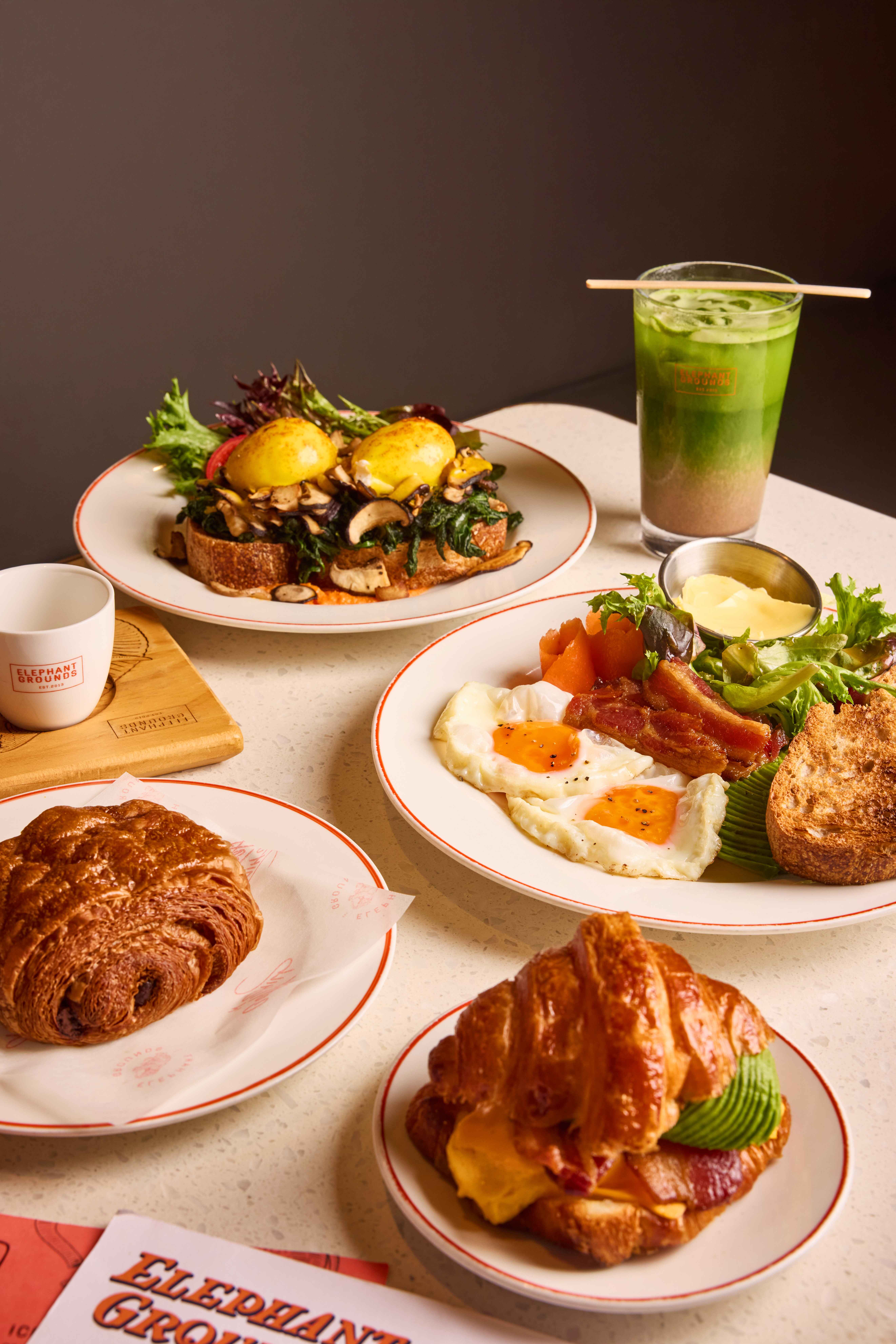 Food offerings at the recently opened Elephant Grounds Singapore
Even design choices become tools for connection. When Poon began curating artwork for the walls of Elephant Grounds, it sparked conversation and online exchange. Social media became not just a marketing platform, but an extension of the physical space.
Looking ahead, Li believes that influence in F&B will continue to be shaped by people rather than systems. Chefs, bartenders, and entrepreneurs remain the industry’s true drivers, responsible for understanding behavioural shifts and evolving alongside them. Technology and trends may accelerate change, but human instinct remains central.
Reflecting on his career, the most unexpected lesson about influence has been its fragility. “Sweat the small stuff,” he says. Details are non-negotiable. A single overlooked moment can erode trust, just as a small, thoughtful touch can elevate an entire experience. Discipline, he believes, is what allows brands to endure.
In an industry often defined by novelty, Li’s influence is quieter and more enduring. It lives in the spaces people return to without thinking, the rituals they build into their days, and the feeling that a place understands them, even before they articulate it themselves.





 Back
Back